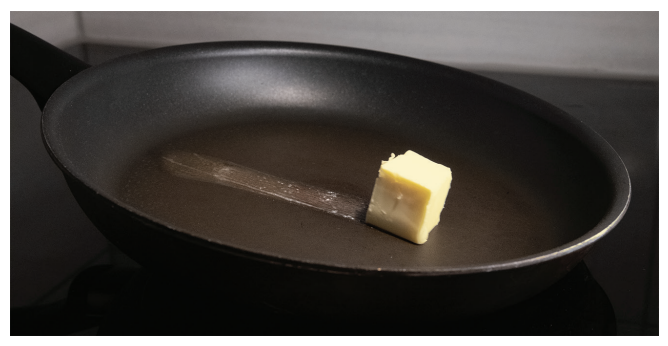
A chunk of of butter sliding across a hot, tilted frying pan could offer insights into the motion of glaciers and lava, and potentially improve lubrication in machinery.
Scientists at the University of Twente in the Netherlans investigated how melting, gravity and friction interact to control sliding speed. Rather than experiment with butter, the researchers placed blocks of ice and paraffin wax on a heated, inclined stainless-steel ramp. As the blocks melted, they produced thin liquid layers that lubricated their movement. Depending on the temperature, slope and material, the blocks traveled at speeds ranging from a snail's typical pace (0.1 meters persecond) to your brisk walk (2 meters per second).
The researchers found that the motion regulates itself. When the lubricating layer becomes thinner, friction increases and the block slows. The thinner layer and slower movement allow heat to reach the melting surface more effectively, thickening the liquid layer and reducing friction. The resulting feedback helps the block settle into a steady sliding speed.
A mathematical model the researchers developed to simulate the sliding overestimated the actual speeds by nearly a factor of 4. The researchers attribute the discrepancy to simplifying the liquid flow on a flat surface.
The findings could help researchers investigate related interactions among heat, melting and motion in glacier movement, lava flows and industrial lubrication. For home cooks, the study helps explain why a block of butter can glide smoothly across a hot, tilted pan as it melts.
The research
Butter on a hot pan: Self-regulating dynamics of melt-lubricated sliding ↗
Edoardo Bellincioni, Simon Biermann, Jacco H. Snoeijer, Leen van Wijngaarden and Sander G. Huisman
Physical Review Fluids · Accepted
DOI: 10.1103/cxz1-2y3n