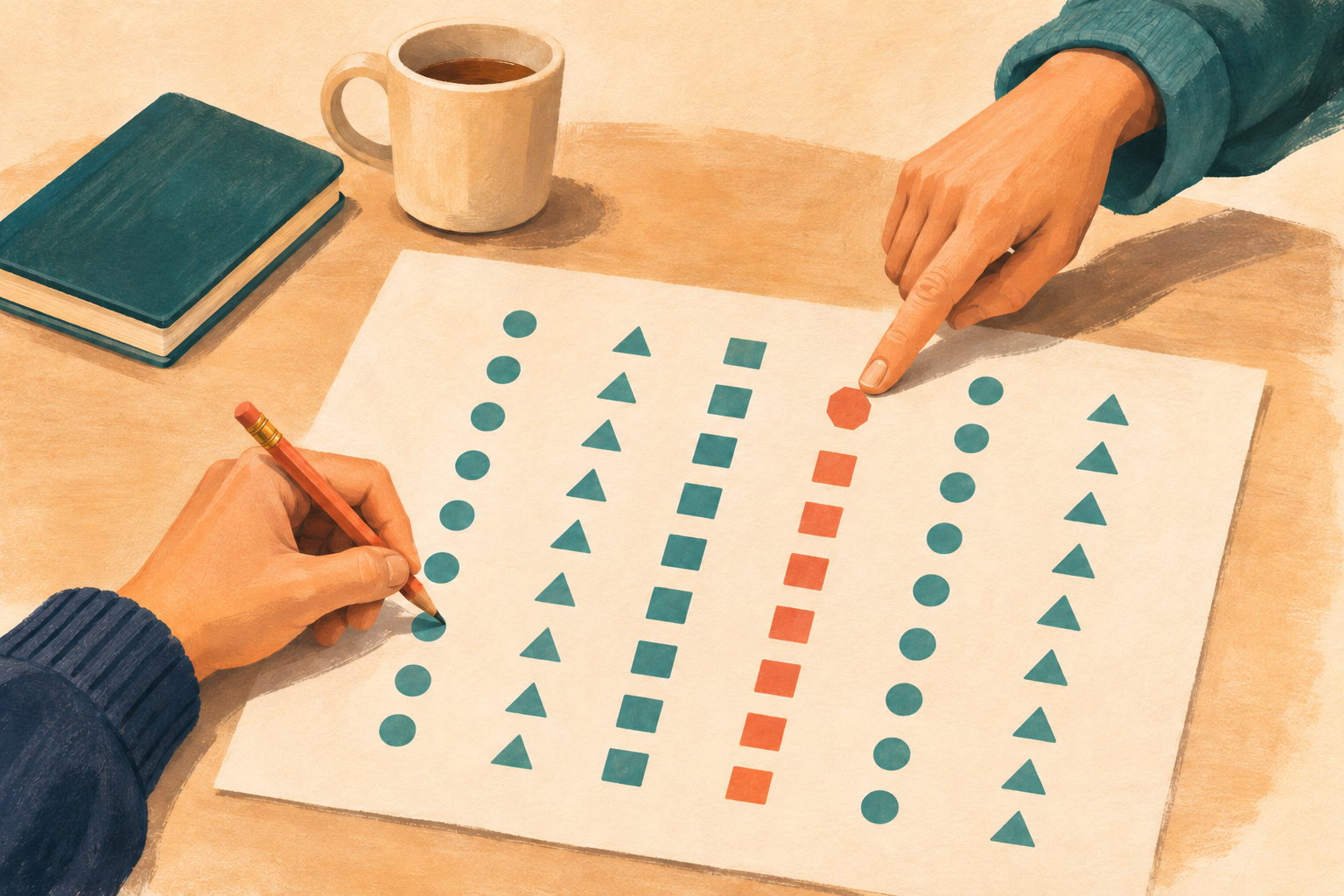
Imagine asking a friend to look over a plan you know inside out. Their first question seems unnecessary. You settled that point ages ago. But explaining the answer sends you back through the details, where something else looks wrong.
Tristan Gagnon-Bartsch, an assistant professor of economics at the University of Iowa, explores a possible explanation with Matthew Rabin of Harvard University and Joshua Schwartzstein of Harvard Business School. Their paper, accepted by The Quarterly Journal of Economics, develops a mathematical theory rather than reporting a new experiment.
The model assumes people have enough evidence to discover their mistakes, but focus on information their existing beliefs make useful. They can overlook a revealing pattern while seeing its individual pieces.
In one example, an investor follows unreliable tips and sees whether investments succeed. Occasional losses seem normal. Yet the investor never keeps the running tally that would expose how poorly the advice performs.
An outsider may investigate a possibility the insider has correctly dismissed. Checking it requires examining evidence the insider no longer needs. That effort can uncover a different mistake shared by both people, even though the outsider began with less knowledge.
The analysis leaves open how often this happens in practice and what people believe after discovering an error. It offers a reason to value another person’s questions, without establishing that outsiders generally make better judgments.
“Interestingly, it is the outsider’s task of discovering what the insider already knows that can reveal the insider’s mistake.”— The authors write in Section 6, “Fresh Eyes,” page 34 of the November 1, 2026 manuscript; quotation from the publication
The research
Channeled Attention and Stable Errors ↗
Tristan Gagnon-Bartsch, Matthew Rabin and Joshua Schwartzstein
The Quarterly Journal of Economics · Accepted
DOI: 10.1093/qje/qjag055