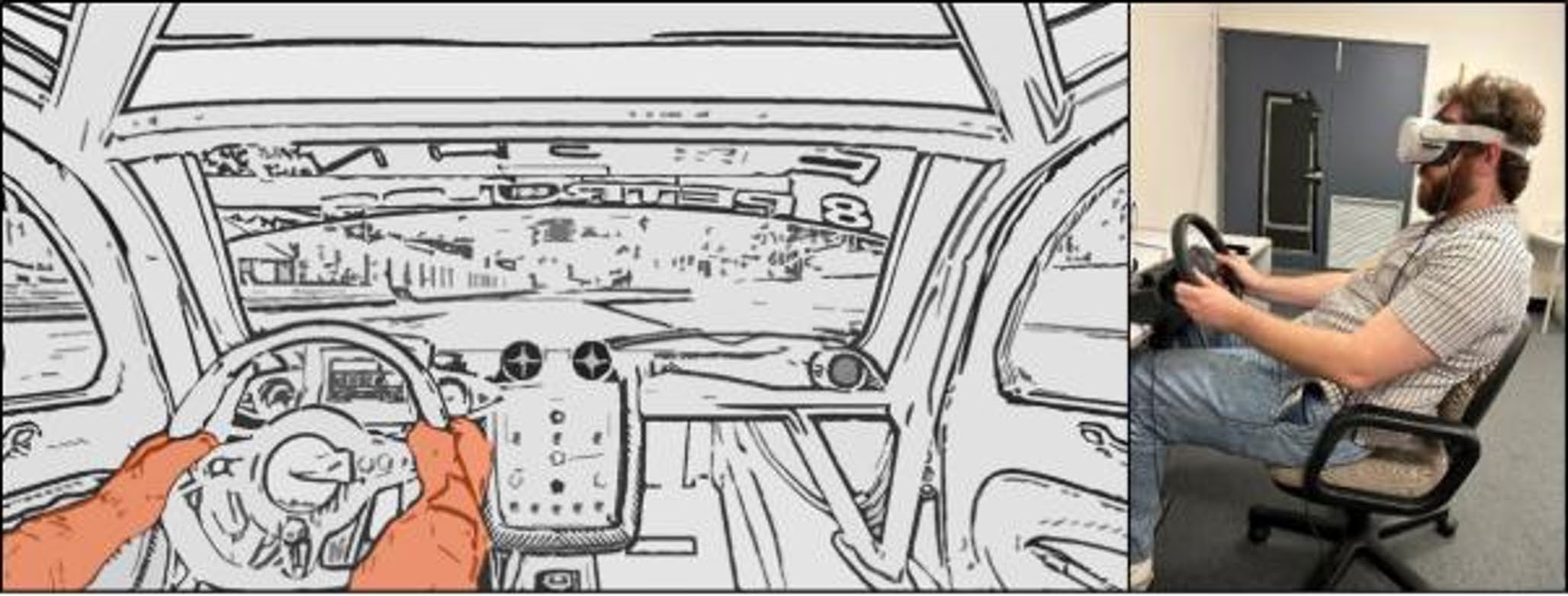
A virtual race left people feeling less sick when they turned a real steering wheel to match the driver they saw in their headset. Working the wheel also made them feel more like they were inside the car, Stephen Palmisano and colleagues report in Virtual Reality. The team wanted to understand why past studies disagree on whether feeling more immersed in virtual reality goes hand in hand with feeling less sick.
Sixty volunteers watched the same recorded race three times, for up to 10 minutes each time. They rode along in the passenger seat, watched from the driver’s seat with their hands in their laps, or copied the virtual driver’s moves with a physical wheel. In that last setup, “participants were not actually steering the virtual car,” the authors write. The recording followed the same course regardless of what they did with the wheel.
The volunteers rated how sick they felt and how much they felt like they were there, both during and after each ride. On the questionnaires they filled out afterward, the steering-wheel setup scored best on both counts. Across the trials, a stronger sense of being inside the virtual world was linked to less sickness on one measure. Finding the simulation more realistic could go with more sickness, especially for people prone to motion sickness.
The authors suggest that giving people a virtual body that moves as they do could help designers make headset experiences feel more convincing and more comfortable. They want to see whether the finding holds when players actually control the car.
The research
Stephen Palmisano, Joel Teixeira, Richard Skarbez and Sebastien Miellet
Virtual Reality · Accepted
DOI: 10.1007/s10055-026-01548-3