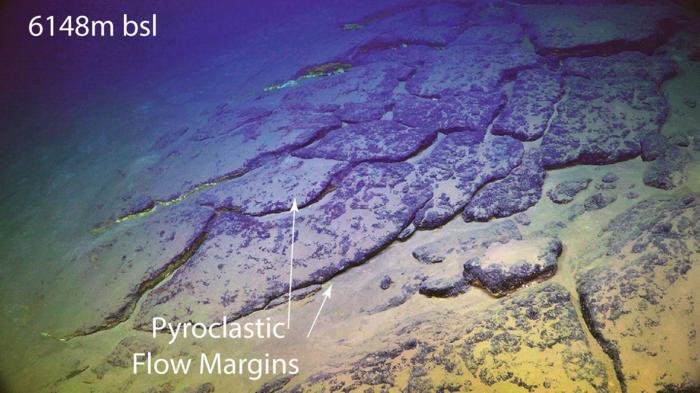
Nearly 4 miles beneath the Pacific, a robot exploring the slopes of the Mariana Trench found thin sheets of volcanic rock with rounded edges. The rocks appear to have formed when hot debris from an explosive eruption swept down the seafloor and fused together.
In late 2024, geoscientist Robert Stern and colleagues sent the remotely operated vehicle Jason to explore near Challenger Deep, the lowest part of the trench. Its cameras photographed the rounded fronts of flows at 6,148 meters, or about 20,200 feet. Farther down, other slabs had intersecting cracks that the team attributes to hot rock shrinking as it cooled.
Rock samples from the dives contained angular volcanic fragments that had stuck together while hot. The researchers describe the rocks as “the deepest known products of submarine explosive eruptions” in Frontiers in Earth Science.
Water pressure there is roughly 600 times atmospheric pressure at sea level, which limits how much fluids escaping from magma can expand. The researchers suspect that hot, highly compressed water released from the magma still expanded enough to break it into fragments. The debris may then have mixed with relatively little seawater as it flowed downhill, keeping enough heat to fuse into solid rock. The team still has to find the vents and pin down when the eruptions happened.
The research
Robert J. Stern, Ignacio Pujana, Molly K. Anderson, Emily J. Chin, Nicholas Dygert, Yumiko Harigane, Veronique Le Roux, Matthew Leybourne, Yasuhiko Ohara, Tomoyo Okumura, George Segee-Wright and Emily Etheridge
Frontiers in Earth Science · Published
DOI: 10.3389/feart.2026.1929806