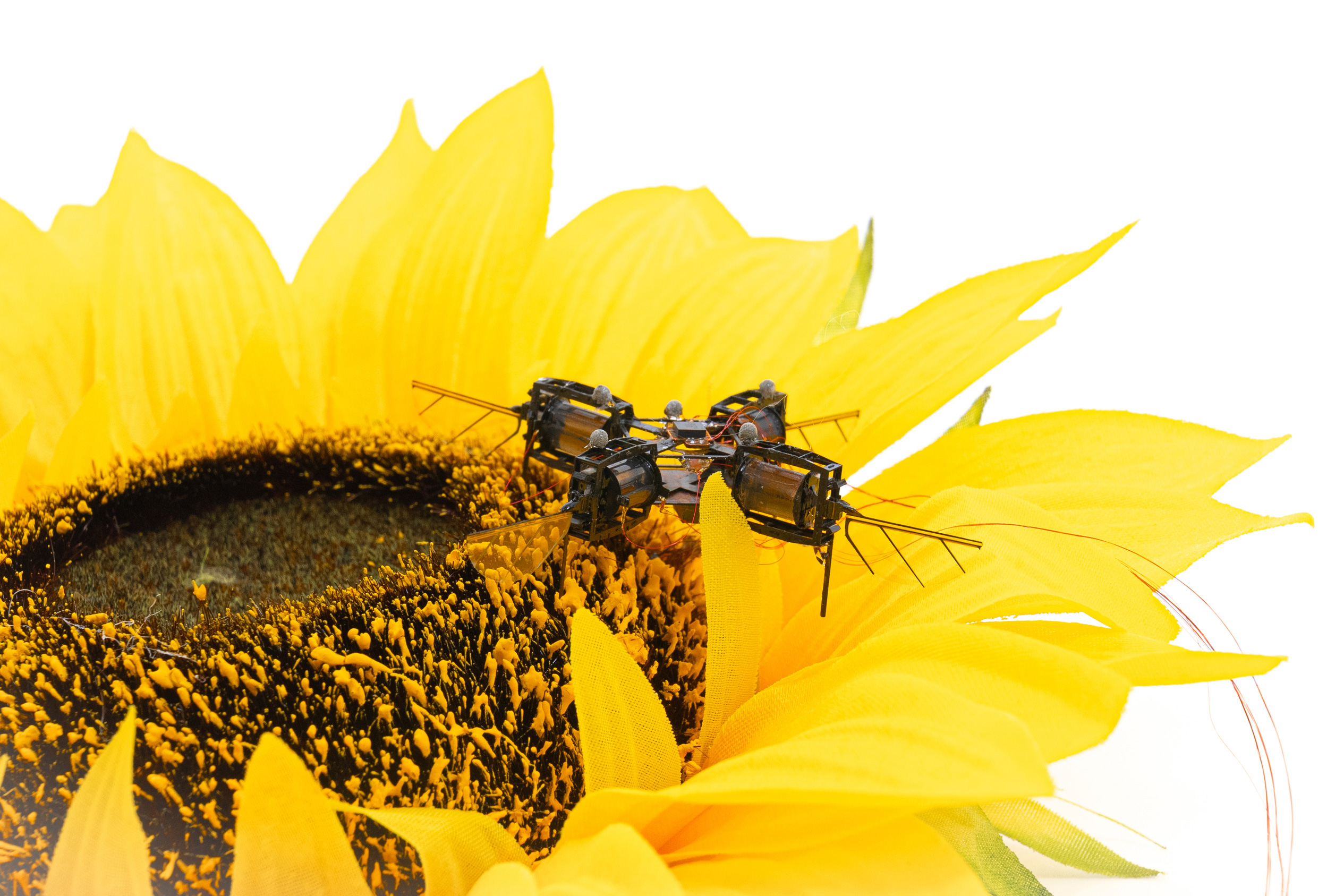
A flying robot weighing about 1.3 grams can keep itself steady and move between destinations using sensors and a computer small enough to ride aboard. It no longer needs a roomful of tracking cameras to tell it where it is.
Kevin Chen, an electrical engineer who heads the Soft and Micro Robotics Laboratory at MIT, and coauthors report the advance November 18 in Science Robotics.
“There are many situations, like pollination or industrial surveillance, where you can’t use a larger robot,” Chen said in an MIT statement.
Getting electronics aboard meant giving the four-winged robot stronger artificial muscles. Enlarging the soft actuators that drive its wings increased lift by 46%, making room for a 244-milligram electronics package.
The package senses tilt and rotation, tracks motion across the ground and measures height using reflected light. Its computer combines those readings and updates flight controls 480 times a second. In tests using onboard computing, the robot hovered for 10 seconds and flew between two targets 30 centimeters apart, with lateral errors averaging about 2 centimeters by the researchers’ measure.
In separate demonstrations, a joystick operator guided the robot around obstacles and onto a sunflower using its onboard sensors. Those flights still used an external computer, the public manuscript specifies; they were not demonstrations of fully independent navigation.
All the flights also depended on an external power supply connected by wires. Batteries, power electronics and the ability to recognize obstacles and plan routes remain future work. Landing on a flower showed a possible step toward robotic pollination, not successful pollination itself.
The research
Yi-Hsuan Hsiao, Quang Phuc Kieu, Zhongtao Guan, Suhan Kim, Jiaze Cai, Owen Matteson, Jonathan P. How, Elizabeth Farrell Helbling and YuFeng Chen
Science Robotics · Published
DOI: 10.1126/scirobotics.aeg6618