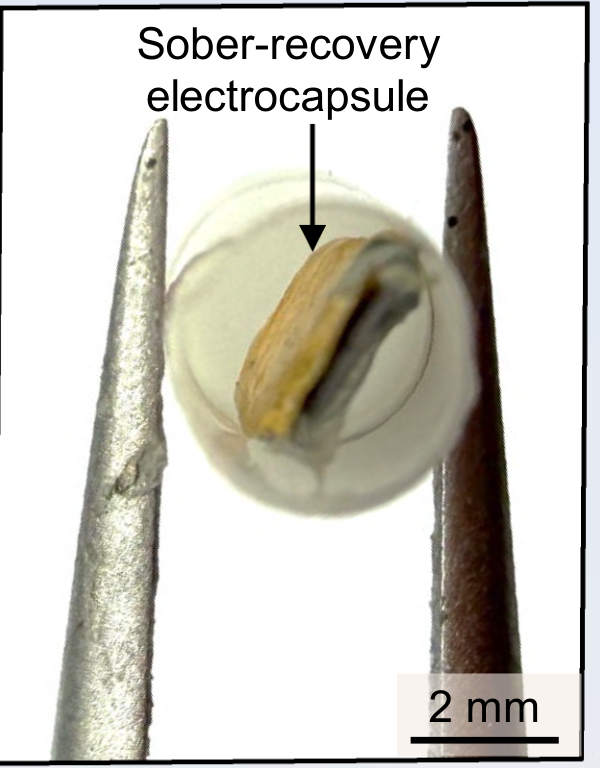
After a drink, the liver has a cleanup job. An experimental electronic capsule aims to intercept some of the alcohol first.
Given to rats before a large alcohol dose, the device lowered blood alcohol concentrations by 58 to 68% over the next six hours, researchers report in a paper accepted in Nature Communications. The animals also recovered from intoxication faster and showed fewer signs of liver injury.
Junling Guo, a biomaterials researcher at Sichuan University in Chengdu, China, and coauthors built a capsule about 5 millimeters long and 3 millimeters wide. Its protective coating is designed to survive the stomach and dissolve in the intestine, exposing the working parts to alcohol-containing fluid.
The authors describe the device as “a self-powered electrochemical reactor” in the paper. A zinc-based unit supplies electrical power, while gold foil coated with manganese and a plant-derived compound helps convert ethanol—the alcohol in drinks—into acetate, a substance the body can further break down. The assembled capsule operates without an external power source.
The rats received two capsules 90 minutes before the alcohol. Compared with animals given empty capsules, they had lower blood alcohol at measurements from 30 minutes through six hours. Treated rats recovered from severe intoxication sooner, as measured by how quickly they regained the ability to turn upright when placed on their backs.
These were small experiments in male rats, with five animals per group for the blood alcohol measurements. The study did not establish that the capsule works in people or can reverse intoxication once alcohol has entered the bloodstream. Several authors are inventors on a pending capsule patent, and some disclose financial interests in therapeutics companies.
Before human use, researchers would need to establish safe dosing, reliable passage through the gut and whether the device can intercept enough alcohol under ordinary drinking conditions.
The research
Yiran Pu, Wenqi Wei, Yuanmeng He, Kai Yong, Mei Chen, Yajing Zhang, Yue Wu, Jiaxin Long, Yunxiang He, Gonghua Hong, Hao Wu and Junling Guo
Nature Communications · Accepted
DOI: 10.1038/s41467-026-79347-2