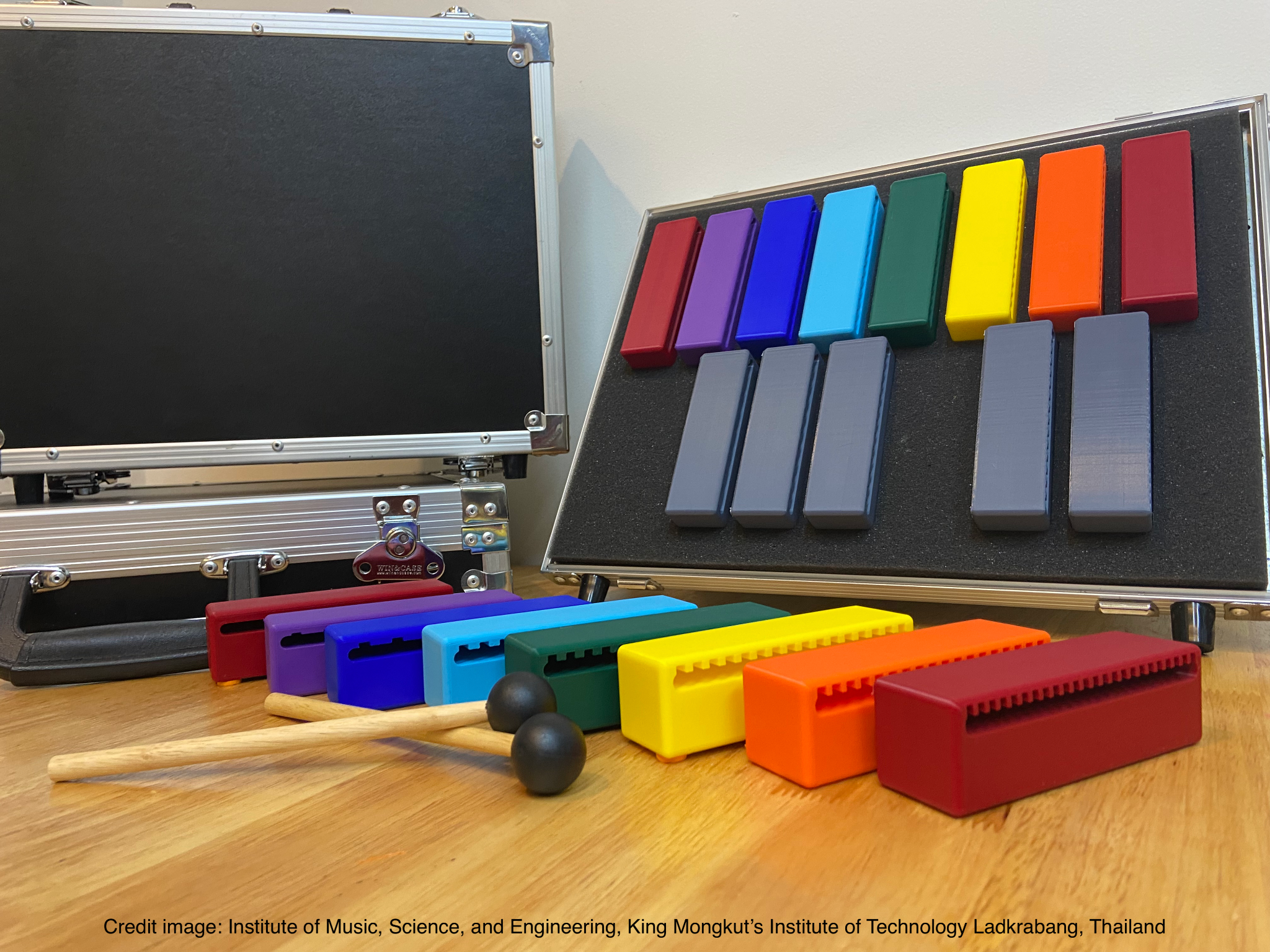
When a part has to fit into a tight space, making it bigger to change how it vibrates may not be an option. A new study shows how engineers can tune those vibrations by printing a pattern of slots inside ordinary plastic. Changing the slots changes how fast the part naturally vibrates, even though its outside dimensions and the type of plastic stay the same. The authors say the pattern inside a part gives designers another way to control how it moves and vibrates, alongside choices about its outer shape and what it’s made of.
A conventional xylophone has long bars for low notes and short bars for high ones. In this 25-second demo, two players tap out a tune on blocks that get four distinct notes out of each size.
Sorasak Danworaphong, a researcher at King Mongkut’s Institute of Technology Ladkrabang in Thailand, and his colleagues printed the blocks from the same type of plastic. They changed the depth, width and number of slots beneath the top surface. The slots make the top easier to bend when a mallet strikes it. That lets the block bend in much the same pattern but vibrate more slowly, producing a lower note. The pitch comes mainly from the plastic vibrating, rather than from air resonating inside the block.
In their paper accepted by Physical Review Applied, the researchers report four higher notes from the smaller blocks and four lower ones from the larger blocks. Together the notes spanned an octave.
The research
Worakrit Thida, Natcha Techaaphonchai, Kittipitch Meesawat, Oliver B. Wright and Sorasak Danworaphong
Physical Review Applied · Accepted
DOI: 10.1103/vnl2-6twc