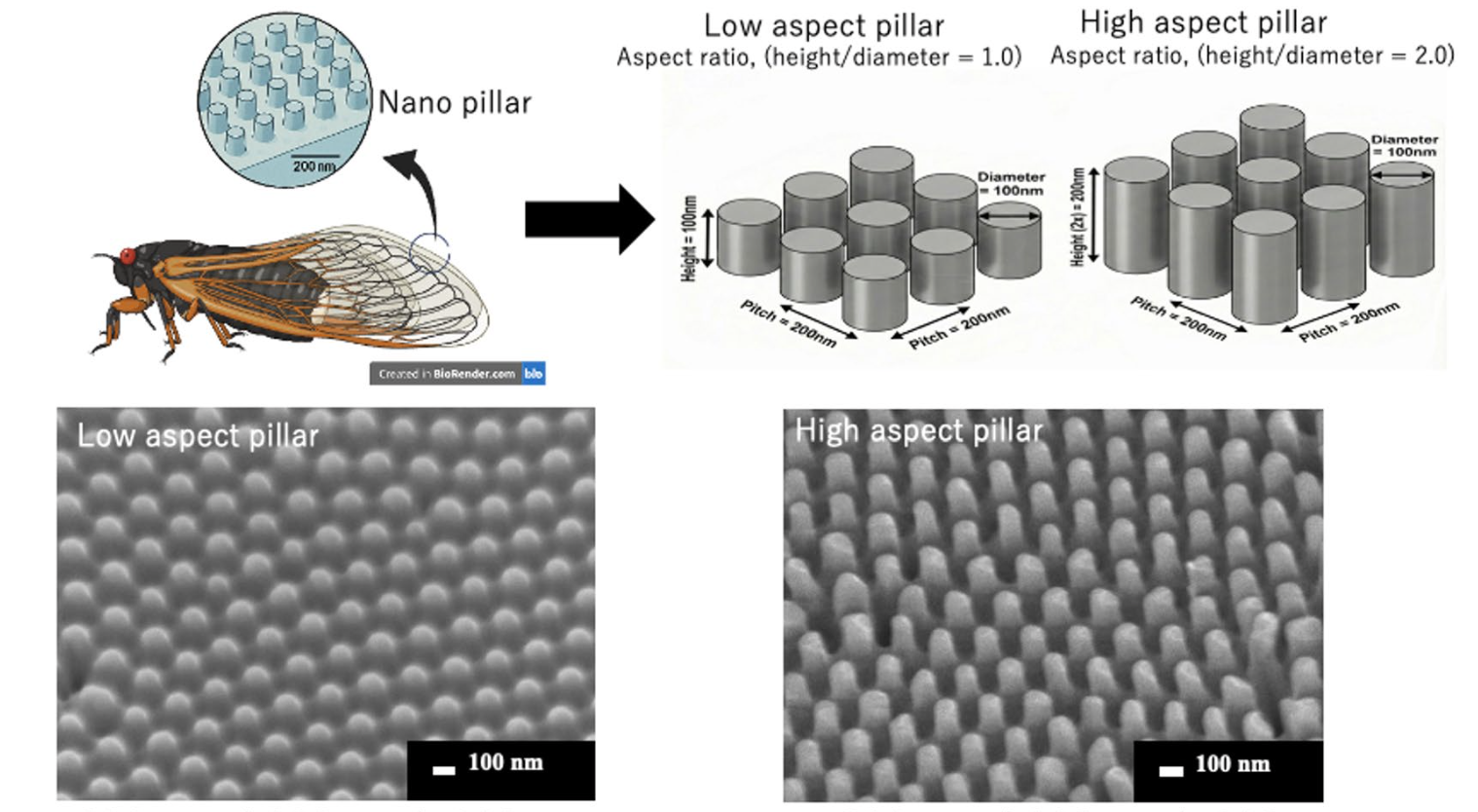
A cicada’s wing looks like a delicate pane of glass crossed by veins. But at a scale too small for your eyes to resolve, its surface can be a landscape of pillars. That hidden texture has inspired researchers to make plastics that are hostile to bacteria.
A new study explores a complication in borrowing that trick: bacteria are not the only cells that respond to a textured surface. Researchers made a transparent plastic covered with cicada-inspired pillars and found both strong antibacterial activity and reduced growth of cultured human cells.
The team pressed a nanoscale pattern into cyclic olefin polymer, a transparent plastic used in products such as lenses and syringes. Each pillar was 100 nanometers wide—one ten-thousandth of a millimeter—with centers spaced 200 nanometers apart. One version had pillars 100 nanometers tall; the other doubled that height.
After E. coli bacteria spent 18 hours on the patterned plastic, fluorescent stains indicated that about 6 percent of the counted bacteria were alive on the shorter pillars and 11 percent on the taller ones. The counts came from five microscope fields per condition. A flat-plastic survival figure cited by the authors came from an earlier study, rather than a concurrent flat-surface control in this bacterial test. Previous research links such surfaces to physical damage to bacterial membranes; these survival measurements alone do not reveal every step of the killing process.
The human-cell experiments asked a different question. Cells from the lining of umbilical veins attached to both patterned and flat surfaces, but those on the pillars spread less readily. After seven days, microscope counts found substantially fewer cells on the patterned plastic. Images also showed changes in actin, a protein that helps form a cell’s internal supporting framework.
That does not mean the pillars killed the human cells as they did the bacteria. A separate test after 14 days measured lower metabolic activity on the patterned surfaces, but the researchers explain that this measurement cannot distinguish fewer growing cells from direct cell toxicity. Their images did not show clear evidence of overt damage. Nor did the study establish the molecular mechanism behind the altered growth.
For a future device inside a blood vessel, the distinction matters. Excessive tissue growth can narrow a passage, yet a healthy lining of endothelial cells also helps blood-contacting surfaces function safely. Slowing those cells is not automatically an improvement. The team still needs tests involving blood flow, clotting and other bacteria before the material’s medical promise can be judged.
The research
Reo Takizawa, Hiroki Bochimoto, Hideki Saito, Saki Shioya, Rinka Shimizu, Takeru Kayahara, Gakuto Inoue, Susumu Minamisawa, Takeshi Ito and Atsushi Nakano
Scientific Reports · Accepted
DOI: 10.1038/s41598-026-78054-8