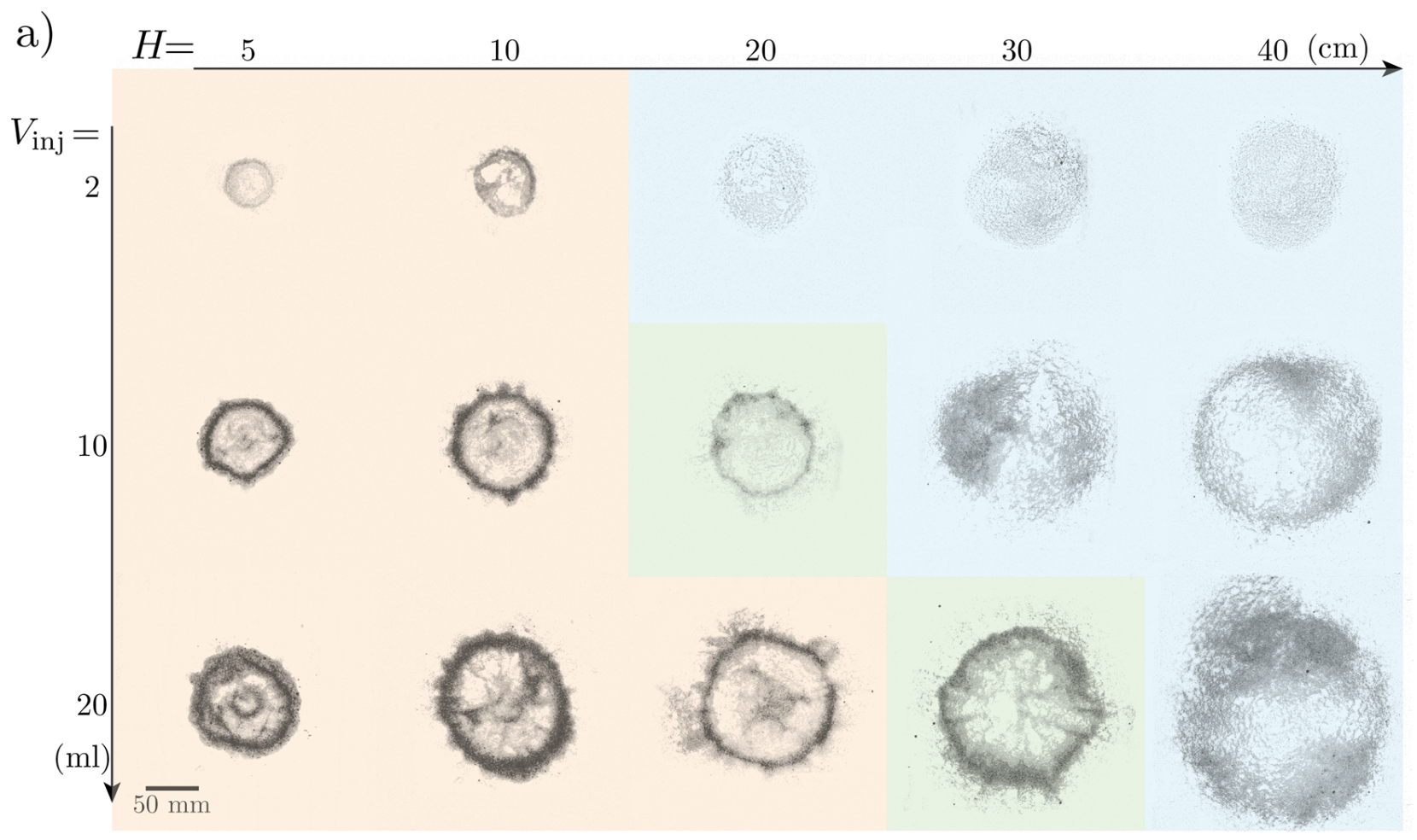
Drop a handful of salt into a pan of water and look at the bottom. Instead of landing in a heap directly beneath your hand, the grains can spread into a ring. The pattern is a brief record of a journey you might otherwise miss.
To investigate, Mathieu Souzy, Clément Vovard and Pallav Kant replaced the kitchen scene with something easier to control: spherical glass beads falling through still water at room temperature. They varied the bead size, the water depth and the amount released, then photographed the deposits. Each set of conditions was repeated five times.
A falling particle disturbs the water around it. Release many together and those disturbances influence their neighbors. The cluster spreads sideways as it descends, carrying water along. When the cloud reaches the bottom, downward motion turns outward, helping spread the particles across the floor.
Give the particles a sufficiently long fall, however, and they spread far enough apart that their collective behavior fades. They settle more independently, leaving a more evenly scattered deposit instead of a distinct ring. The distance at which that transition happens depends on the particles and the cloud.
The way the beads entered the water mattered as well. Releasing them gradually through a narrow pipette produced a different result from dropping a compact cluster. With larger amounts in the pipette experiments, a pile formed rather than a ring with a depleted center.
The researchers even mixed two bead sizes. The larger beads tended to collect farther out, suggesting a possible way to sort particles. The distributions still overlapped; this was a promising observation, not a finished sorting technology.
For a cook, the pleasure is simpler: a pattern at the bottom of a pan can reveal motion that has already happened. This is about grains settling through water, rather than a chalky rim left after water evaporates.
The authors keep the kitchen connection alive through the acknowledgments. After invoking a cooking rule of 10 grams of salt to 100 grams of pasta and 1,000 milliliters of water, they add a cheerful disclaimer:
“The authors also decline any responsibility for the potential fierce domestic disputes that may follow the application (or rejection) of the aforementioned Golden Rule.”— The authors write in Acknowledgments, journal page 013370-7; quotation from the publication
The research
Salt-ring in your pasta pan: Morphology of particle cloud deposit ↗
Mathieu Souzy, Clément Vovard and Pallav Kant
Physics of Fluids · Published
DOI: 10.1063/5.0239386