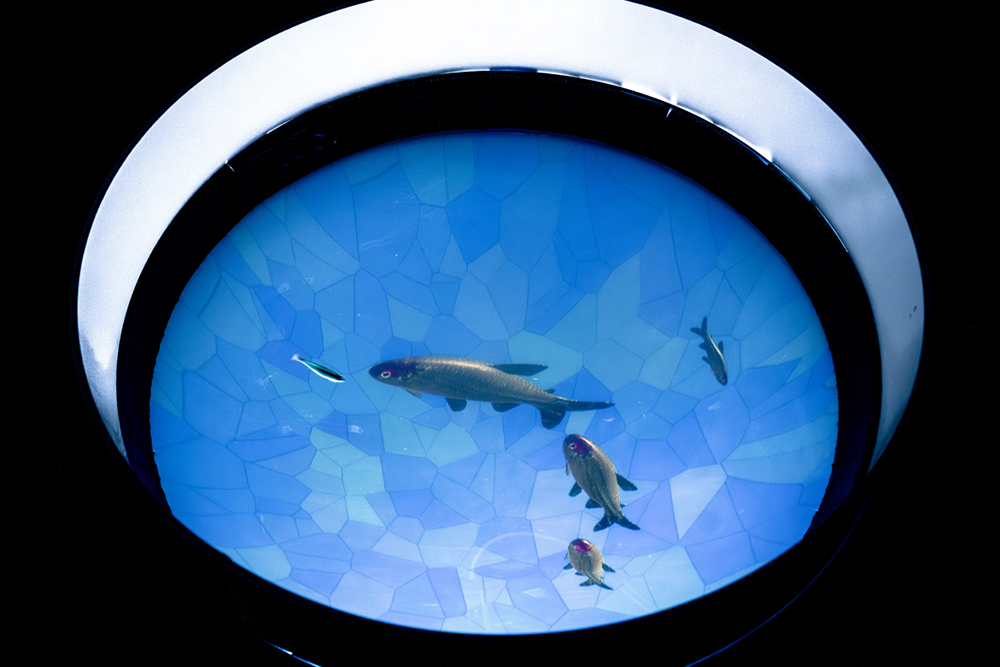
A rummy-nose tetra swam around a bowl with four fish projected onto its curved wall. A camera tracked the live fish, and the projections responded to its movements in real time. The tetra changed course in response to them, too.
Zhen Kang and colleagues programmed each virtual fish to take cues from one, two or four neighbors, then watched how a live tetra swam with the group under each set of rules. They compared its movements with computer simulations of what the tetra would do if it, too, responded to one, two or four neighbors at a time. The team reports the results in PRX Life.
The live fish regularly made sharp turns, some greater than 90 degrees. The simulations reproduced those turns only when the model fish took its cue from the neighbor that had the greatest effect on its movement at that moment. Which fish had that influence could change as the group moved. As the researchers write, “the most influential neighbors of the real fish are not always the nearest ones.”
Following one neighbor at a time may be enough to keep fish swimming together. The projections supplied visual cues alone. In a live school, fish can also sense the water set in motion by their neighbors. Whether the same rule holds in larger schools of live fish remains open.
The research
Decoding Social Integration in Schooling Fish Using Closed-Loop Real-Virtual Interactions ↗
Zhen Kang, Ramón Escobedo, Maud Combe, Stéphane Sanchez, Clément Sire and Guy Theraulaz
PRX Life · Published
DOI: 10.1103/18qw-sfyd