A stolen password can open a digital door from almost anywhere. Quantum physics could someday add a different requirement: being in the right place.
Krister Shalm, a physicist at the National Institute of Standards and Technology in Boulder, Colorado, and an international team tested a way to check where a device is using tiny particles of light. The experiment, reported in Nature, could help banks or power companies confirm that a request comes from an approved location.
“Our results show how digital security can instead be anchored to the physical world,” Shalm said in a NIST statement.
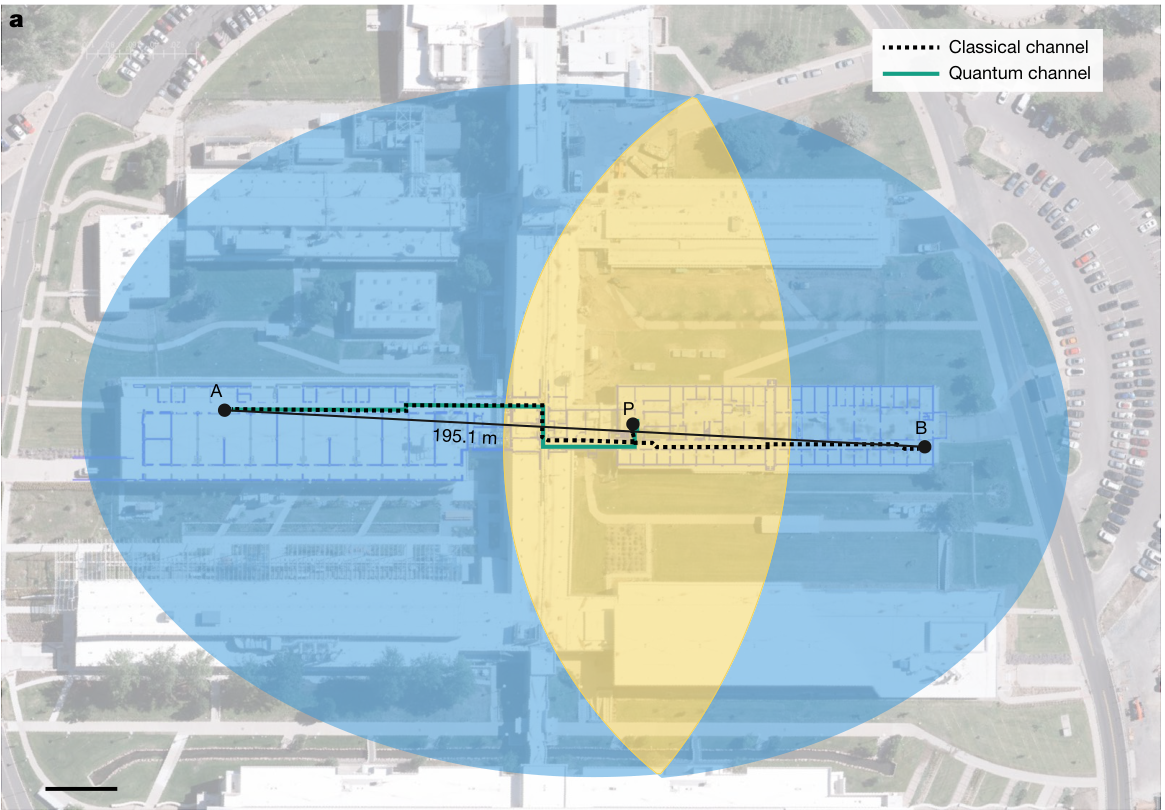
The team placed two checking stations about 195 meters apart and a third station between them. The stations used pairs of light particles whose measurement results are linked by quantum physics. Random instructions told the middle station how to measure its particle.
The checks had two parts. Over millions of rounds, the stations’ answers formed a pattern that could not be explained simply by agreeing on answers beforehand. The middle station also had to reply within a strict time limit. Because signals cannot travel faster than light, equipment in the wrong place could take too long to answer.
Combining those checks narrowed the device’s possible location to a space about one-quarter as large as a similar check using ordinary signals alone, allowing for the same delays in the equipment.
This was a test of laboratory equipment, with limits on the quantum tools available to would-be attackers. It does not establish protection against every possible attack, and no working banking system was tested. Practical use will require networks that can send quantum information and may be more than a decade away, study coauthor Scott Glancy said in the NIST statement.
The research
Quantum position verification with remote untrusted devices ↗
Gautam A. Kavuri, Yanbao Zhang, Abigail R. Gookin, Soumyadip Patra, Joshua C. Bienfang, Honghao Fu, Yusuf Alnawakhtha, Dileep V. Reddy, Michael D. Mazurek, Carlos Abellán, Waldimar Amaya, Morgan W. Mitchell, Carl A. Miller, Richard P. Mirin, Martin J. Stevens, Scott Glancy, Emanuel Knill and Lynden K. Shalm
Nature · Published
DOI: 10.1038/s41586-026-11247-3