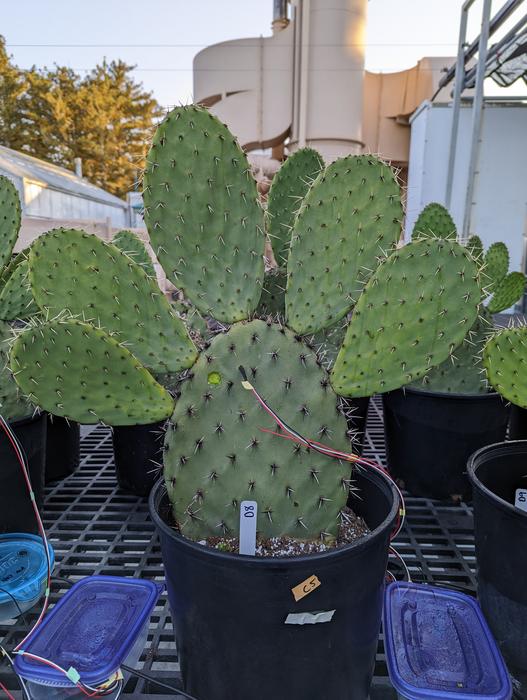
A cactus’s water-saving chemistry can do more than keep it alive. Researchers have tapped that daily chemical cycle to draw small amounts of electricity from prickly pear pads, the plants’ broad, fleshy stems.
Charlie Chesney, who led the project while earning her doctorate in environmental studies at the University of California, Santa Cruz, and coauthors report the findings November 19 in Plants, People, Planet. The work points toward a possible power source for tiny agricultural sensors.
Prickly pears open their pores at night, taking in carbon dioxide when cooler temperatures limit water loss. They store that carbon in malic acid, then release it for photosynthesis during the day. Unequal light on opposite sides of a pad creates differences in acidity that help drive an electrical current between inserted electrodes.
The electrical signal changed with lighting conditions and the season. “Just how closely the voltage aligned with the sunlight conditions was really surprising,” Chesney said in a university statement.
Turning that signal into a dependable power supply will take more engineering. Voltage alone does not establish how much usable power a plant can deliver, and the experiments did not demonstrate an independently operating cactus-powered farm sensor. The plants also began sealing wounds around electrodes after about three days, forcing the team to reposition the connections.
Eight stems tested after 15 months without watering still produced electricity, even after becoming much thinner. Their electrical output generally held up under the tested light conditions. That resilience could be useful in dry places, although it also means voltage may be a poor indicator that a cactus needs water.
Prickly pears are already grown for their edible pads and fruit. The team envisions adding energy-harvesting circuitry and storage to collect the plants’ small electrical output for sensors monitoring crops or field conditions. A crop that supplies food could eventually help keep watch over the farm, too.
The research
Charlie M. Chesney, Joe Zheng, Erin Langness, Angelina Powers, Kai Ando, Ben Walker-Edwards, Sahithi Adiraju, Miles Johnson, Evelyn Cooper and Michael E. Loik
Plants, People, Planet · Published
DOI: 10.1002/ppp3.70295