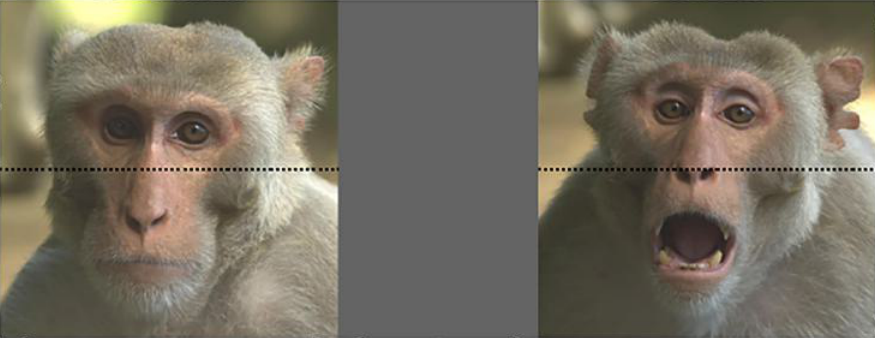
When a face appeared on a screen, three rhesus macaques tended to look at its lower half. Other macaques in the same test looked higher. The difference showed up years after the three monkeys, which saw very few faces early in life, began seeing them regularly.
A glance at a face can tell you who someone is, how they’re reacting or where their attention has shifted. Reading those details helps people pick up social signals, including “cues, such as gaze and head direction,” Harvard Medical School neurobiologists Saloni Sharma and Margaret S. Livingstone write in their November 19 paper in Nature Communications. They point to a similar distinction in research on people born with cataracts. After treatment, people can learn to spot faces, while finer differences between faces can remain hard to see.
Lab staff hand-reared the three males while wearing welders’ masks, limiting the animals’ exposure to faces for roughly the first year or two of life. After years of ordinary face exposure, the monkeys spent substantial time looking at faces, much like the comparison animals.
Brain recordings taken four to eight years after the early restriction ended revealed a difference the eye tracking alone could miss. The animals’ brain signals carried less information for telling neutral from threatening expressions. The differences for telling faces apart by identity or viewing angle were less clear. How the three animals used facial cues in actual social encounters remains an open question.
Hands offered another clue. Many brain cells in the monkeys that had seen few faces responded strongly to pictures of both hands and faces. The comparison animals’ cells responded more strongly to faces. The authors suggest that the animals had spent much of their early lives with hands to watch, including their own as they handled food and climbed.
The research
Saloni Sharma and Margaret S. Livingstone
Nature Communications · Accepted
DOI: 10.1038/s41467-026-79612-4