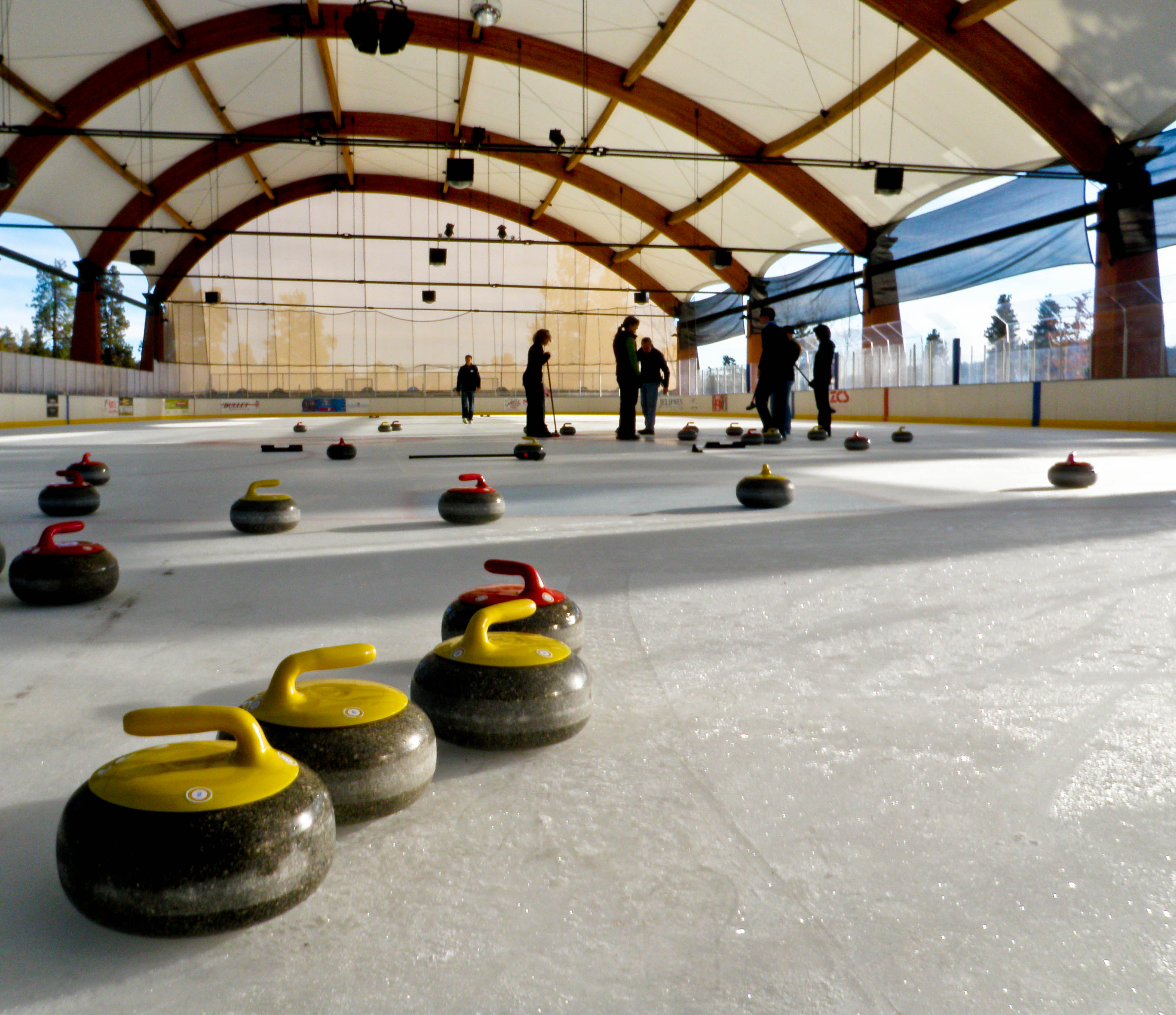
A curling stone glides across the ice while friction steadily slows it down. But that same friction may also help the stone slide. New research suggests that the warmth generated where surfaces rub together can make ice much more slippery, even without heating it enough to melt.
The finding offers a fresh explanation for a familiar winter puzzle. Researchers have long debated how much ice owes its slipperiness to pressure, heating or the behavior of molecules at its surface. The new study connects two pieces of that puzzle: a thin, liquid-like layer that can exist before anything moves, and the changes that occur when sliding warms it.
At the University of Oslo in Norway, chemistry researcher Sigbjørn Løland Bore and physics researcher Henrik Andersen Sveinsson worked with B. N. J. Persson, who studies friction at Forschungszentrum Jülich in Germany. Together they simulated glass sliding over ice. Their glass was amorphous silica, a useful stand-in for rock-like surfaces. Granite curling stones contain abundant silica, making their motion a relevant comparison. The study has been accepted by Physical Review Letters.
The researchers began at the scale of atoms. They used machine learning trained on quantum-mechanical calculations to model the forces between atoms in the ice and glass. Those simulations revealed a lubricating film at the boundary, including when the surfaces were still.
But the atomic picture alone gave the wrong answer about sliding. It predicted too much friction, and friction increased as the glass moved faster. Existing experiments showed the opposite trend.
The missing ingredient was heat moving through larger pieces of material. The team combined its atomic results with a model of frictional heating at the small patches where the surfaces actually touch. As sliding speed increased, those patches warmed toward the melting point, changing the film between them.
Across the modeled conditions, the film became roughly ten times thicker, while its viscosity, or resistance to flow, fell by about a factor of 100. Together, those changes allowed the surfaces to slide with less resistance.
The warming did not have to create a film from scratch. A process called premelting had already produced the liquid-like layer below the bulk melting point. Frictional heat changed that layer’s thickness and behavior without requiring the solid ice to undergo ordinary thermal melting.
With heating included, the predictions closely matched earlier measurements involving glass and curling stones. The researchers used some slow-sliding measurements to calibrate their model, then checked it against 55 measurements from four other sources that had not been used for that calibration.
The result does not settle how every material slides on ice. Metal blades conduct heat differently, and snow, ski wax and surfaces that gouge the ice involve effects the study did not examine in depth. Nor does it establish a safe walking speed on an icy sidewalk.
For glass and rock-like contacts, though, the study gives friction a double role. It resists the slide while generating warmth that makes the next part of the slide easier.
The research
Sigbjørn Løland Bore, B. N. J. Persson and Henrik Andersen Sveinsson
Physical Review Letters · Accepted
DOI: 10.1103/9wv5-ypdm