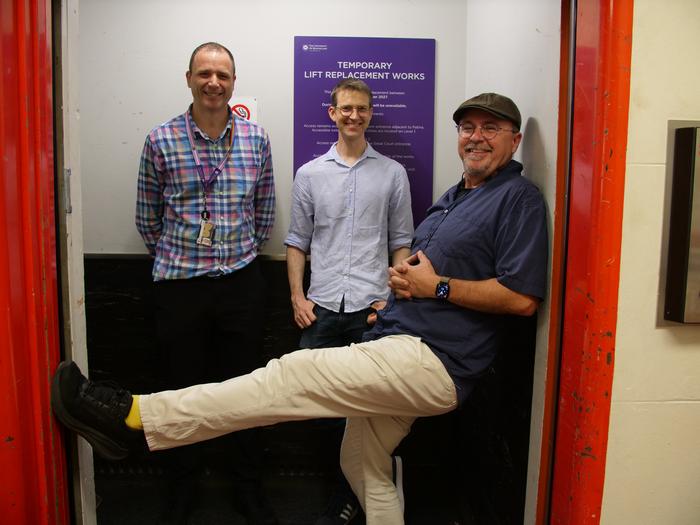
An old elevator has picked up a new job: sending messages with gravity.
By moving the elevator’s heavy counterweight up and down, physicist Matthew Davis of the University of Queensland in Brisbane, Australia, and colleagues sent the word “Gravity” through a brick wall. The demonstration, reported November 18 in Science Advances, shows how information could travel through barriers that stop conventional wireless signals.
Every object with mass exerts a gravitational pull. Move a heavy object closer to a sensitive gravity detector, and that pull changes. The researchers turned those tiny changes into a code: one counterweight position represented a zero, the other a one.
Their transmitter was a 1950s elevator with a counterweight weighing about 1.8 metric tons. Their receiver, a gravity-measuring instrument called a gravimeter, sat in an adjacent bathroom. A brick wall separated it from the elevator shaft.
With the counterweight about 70 centimeters from the detector at its closest position, the team recovered the message correctly after accounting for Earth’s tides and slow drift in the instrument’s readings. Sending one bit each minute, the system took about an hour to deliver its seven-letter greeting.
“It’s not often that you get to demonstrate an entirely new way of communicating,” Davis said in a university news release.
The appeal is that ordinary materials cannot shield gravity the way metal can block radio signals. But the experiment offers a principle, rather than a practical replacement for Wi-Fi. The demonstrated range was short, and moving heavy machinery made transmission slow. Vibrations and other moving masses could also interfere with the signal.
Faster machinery and more sensitive detectors might improve performance. For now, the message from this elevator is brief—and worth the wait.
The research
Unblockable communication with gravity ↗
Andrew J. Groszek, Charles W. Woffinden, Michael D. Harvey, Andrew G. White and Matthew J. Davis
Science Advances · Published
DOI: 10.1126/sciadv.aee0802