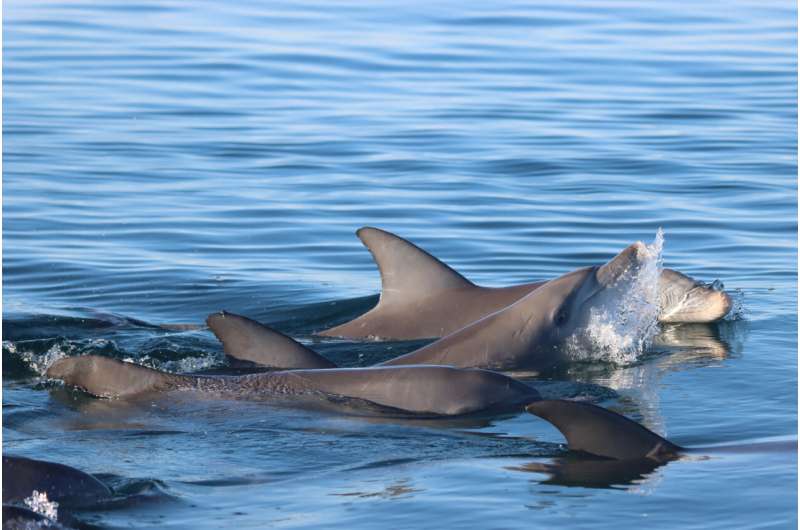
Dolphins can switch groups several times in an hour. Over decades, those gatherings take on a pattern. In Western Australia’s Shark Bay, older bottlenose dolphins were usually seen in smaller groups than they were in their prime, and the number of companions varied less across sightings.
Using four decades of records, Kelley Meehan, a dolphin behavior researcher at the University of Queensland in Australia, and coauthors analyzed nearly 65,000 observations of 457 wild Indo-Pacific bottlenose dolphins. Groups tended to grow through youth and early adulthood. The later decline in group size was steeper among males, the team reports November 24 in PLOS Biology.
People often become more selective about whom they spend time with as they age, the authors note. The researchers analyzed head counts from brief sightings, so they could tell how many companions a dolphin had on a given day. A dolphin regularly seen with six others might have different company each time. Individual habits varied, too. In a PLOS statement, Meehan said that “each animal has a personality as unique as a fingerprint.”
Dolphins with larger, more consistently sized groups tended to be sighted at older ages. The team used age at last sighting as a stand-in for longevity. How much group size contributes to survival is still unclear. A dolphin in poor health, the researchers suggest, might have trouble moving around and spend less time with others.
The research
Kelley C. Meehan, Barbara Class, Shinichi Nakagawa, Meredith MacQueeney, Vivienne Foroughirad, Janet Mann and Celine H. Frère
PLOS Biology · Published
DOI: 10.1371/journal.pbio.3004022