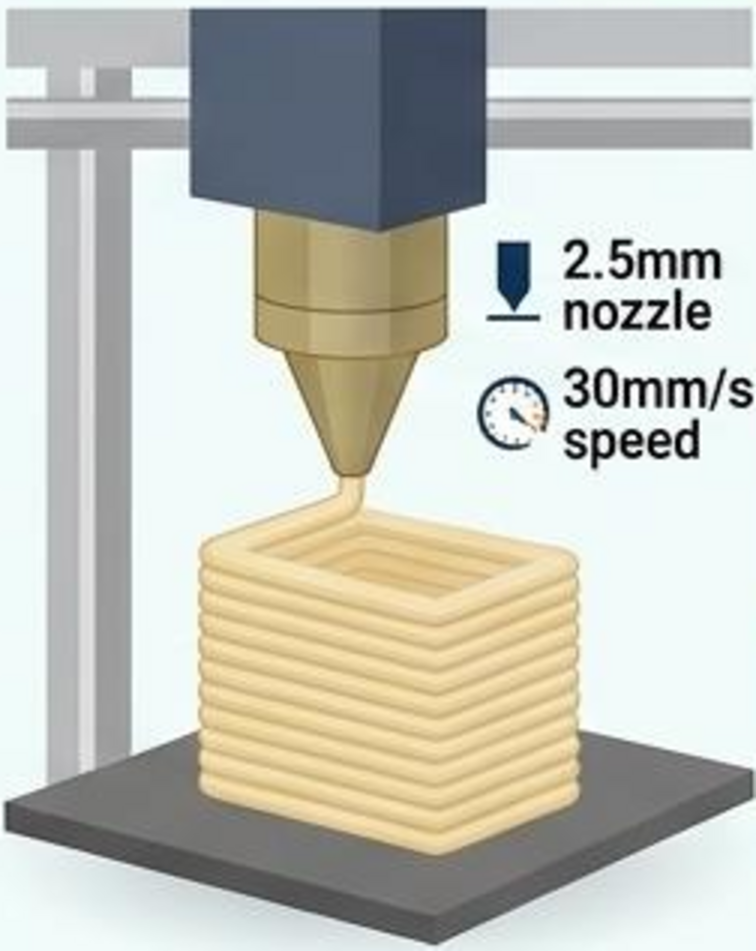
For someone who needs soft food, a meal can come in a bottle. Liquid supplements are convenient, but “they often lack visual appeal,” Wares Chancharoen, a medical innovation researcher at Chulabhorn Royal Academy in Bangkok, and coauthors write in the International Journal of Food Science and Technology. Their alternative began with Thai rice flour and a 3D printer. The result held its shape on a plate and yielded under a fork.
The trick was getting a paste to do two jobs. It had to flow through the printer’s nozzle, then hold up as the nozzle laid down the next layer. The team mixed rice flour with ingredients including whey protein, sugar and soybean oil. Adding a gel made with sodium alginate let the paste withstand more pressure before it began to flow. Yet once printed, the bites made with gel took less force to squash than those made without it.
At Chulabhorn Hospital in Bangkok, 24 adults who had completed chemotherapy within the previous year tasted four recipes. Average ratings ranged from 6.1 to 6.7 on a 9-point scale for overall liking, with no clear favorite. The volunteers had no diagnosed swallowing disorder, and the test measured how the food felt to eat. Establishing which textures are safe for people who have trouble swallowing would take a clinical swallowing assessment.
The researchers would also like to experiment with flavor and presentation. Their test pieces were just 1.5 centimeters on a side. A printer gives a cook some room to play with what a bite looks like while keeping it soft enough for a fork to leave its mark.
“they often lack visual appeal”— The authors write in Introduction, first paragraph, on conventional liquid dietary supplements; quotation from the publication
The research
Wanassanan Chansataporn, Yossaphol Kaewkumpha, Morrakot Suwannakan, Yanee Pumcharoen and Wares Chancharoen
International Journal of Food Science and Technology · Accepted
DOI: 10.1093/ijfood/vvag250