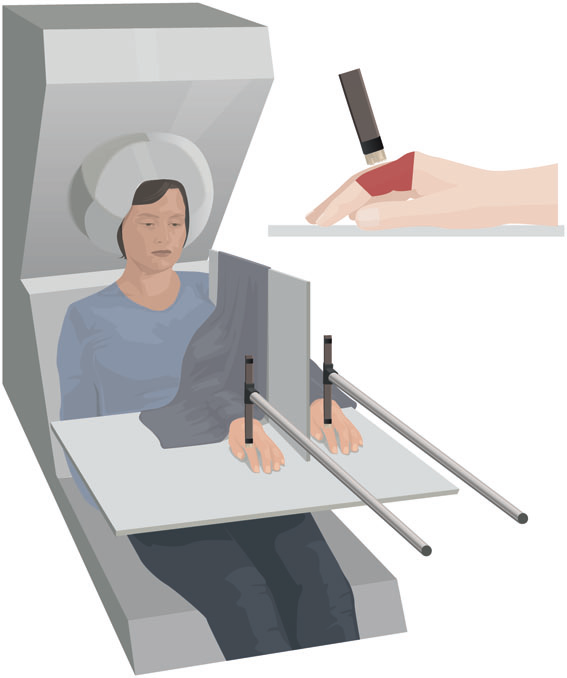
Look at your hand and you know without thinking that it belongs to you. But watch a brush tap a rubber hand while a second brush taps your hidden hand in sync, and the rubber hand can start to feel like yours. Once that illusion takes hold, your brain can respond to the approaching touch before either brush lands.
Maximilian Hauser and colleagues recorded brain activity in 45 volunteers as robotic brushes delivered light taps. In one test, volunteers saw the rubber hand being tapped and felt matching taps on their hidden left hand. In another, they watched the brush tap their own uncovered hand. The researchers report the results in Nature Communications.
In the detailed brain analysis of 28 volunteers, the team found patterns of activity shared by the illusion and the test with the visible real hand. One peaked about 80 milliseconds before contact, as the brush moved toward the hand. About an eighth of a second after contact, activity in other regions suggested the brain was bringing sight and touch together. Later, more regions on both sides of the brain became involved.
The team timed those signals around individual taps after the illusion had taken hold. The activity before contact, the authors write, highlights “the importance of anticipatory processes as a component of body ownership.” An expected touch, it seems, can be part of what makes a hand feel like yours.
The research
Spatiotemporal brain dynamics of limb ownership perception ↗
Maximilian F. A. Hauser, Sara Coppi, Daniel Lundqvist and H. Henrik Ehrsson
Nature Communications · Published
DOI: 10.1038/s41467-026-79003-9