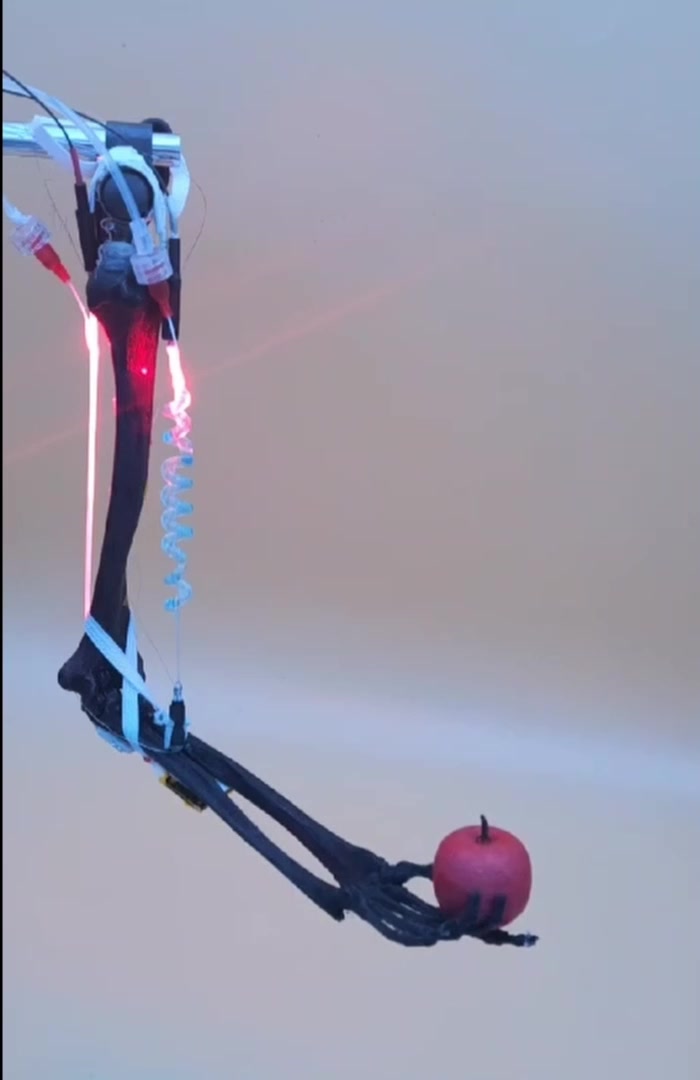
Close your eyes and curl a finger. Your muscles help you sense it move. Engineers have built artificial muscles with a similar ability. In a lab test, two of them bent a model arm holding a 3D-printed apple and provided signals that helped track the arm’s angle.
Bioengineer Seongjun Park of Seoul National University in South Korea led the work, reported November 20 in Nature Communications. Each artificial muscle is a thin fiber with a stretchy channel for water and a stiffer strand that carries light. Pump water in and a bulge travels along the channel, a process the researchers compare to “the nonuniform inflation of long balloons” in the paper’s results. The stiffer strand resists stretching, so the fiber curls and shortens.
The curl changes how much light makes it through the fiber. In the model arm, the fibers pulled in opposite directions, like the biceps and triceps. The team used the light signals and the amount of water pumped into the fibers to estimate how far the elbow had bent.
The fibers contracted reliably for more than 100 cycles in lab tests, though their rubbery walls could eventually rupture with repeated use. The researchers also tried the design on a smaller scale. A single fiber just 0.15 millimeters thick could twitch the antenna of a model ant. Moving one of its stiffer legs took a bundle of three.
The research
Hyperelastic microfibers as bioinspired proprioceptive artificial muscles ↗
Joonhee Won, Jaehyun Jang, Hyunseo Kim, Inyoung Choi, Kyunghyun Jo, Yunheum Lee, Jiheong Kang, Steve Park, Gun-Hee Lee, Yong-Lae Park, Hyunwoo Yuk, Carmel Majidi and Seongjun Park
Nature Communications · Accepted
DOI: 10.1038/s41467-026-79467-9