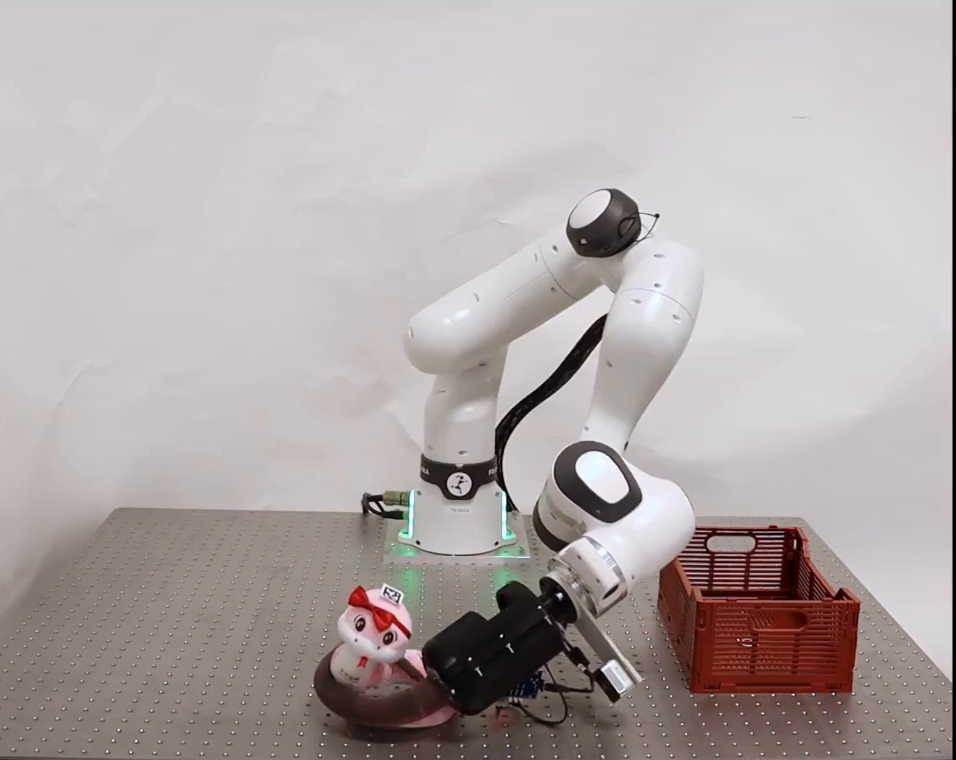
Give a robot the wrong coordinates for a cup, toy, or other object, and its pincers may close on thin air. A robot in a Dutch lab can reach off to one side and still make the grab. A soft extension at its wrist curls like an octopus arm, wrapping around small objects and drawing them in.
Roboticist Mariano Ramírez Montero of Delft University of Technology and his colleagues fitted a rigid robot arm with a 38-centimeter length of tapered silicone. Pulling one cord inside the silicone makes it bend. Pulling the other makes it twist. To teach the robot a task, a researcher guides the rigid arm by hand and presses buttons to work the cords. The team describes the robot in a paper accepted by Nature Communications and posted November 26.
To test the robot’s aim, the team deliberately shifted the apparent position of a cylindrical object by 5 to 15 centimeters in different directions. The researchers then mapped the spots the robot could aim for and still get a grip. For the octopus-like arm, that patch covered an estimated 252 square centimeters, more than 4 times as large as the runner-up’s. That gripper, also soft, managed about 61. The arm’s extra reach helped, and its wraparound grip meant that “the object can be pulled in from many different poses,” the team writes in its account of the grasping test.
The robot could manage a more exacting job, too. A researcher showed it once how to lift a large cup on the right and stack it over a smaller one on the left. Then the team moved the cups. A camera read tags on them so the robot could adjust its route. It made the stack in 19 of 20 trials. In half the trials, the cups had switched sides and the robot had to do its lesson in reverse.
The research
Learning beyond rigid manipulation with hybrid soft-rigid robots ↗
Mariano Ramírez Montero, Ebrahim Shahabi, Giovanni Franzese, Jens Kober, Barbara Mazzolai and Cosimo Della Santina
Nature Communications · Accepted
DOI: 10.1038/s41467-026-79571-w