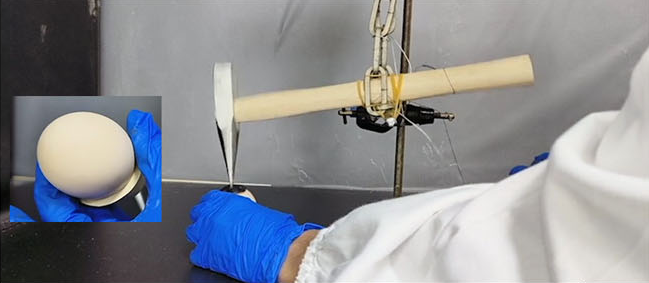
A hammer struck an egg again and again. The shell held. A soft polymer cushioned the blows, stiffening each time it took a hit. In a separate test, the same material protected a glass slide from a falling steel ball.
Lingyan Gao, a chemist at Northwest University in Xi’an, China, codirected the project with Bo Zheng at the same university and Feng Wang at the University of Science and Technology of China. The team wanted to make a material that stays flexible in ordinary use and stiffens fast enough to cushion an impact. They report the results in a paper accepted by Nature Communications.
The researchers think the timing comes down to tiny molecular rings threaded onto branches of the polymer’s long chains. During a slow squeeze, the rings have time to slide off, leaving the chains free to move. A sudden hit arrives too quickly for the rings to slip free. With those junctions still in place, the material briefly stiffens.
The glass experiment suggests why the material might appeal to anyone who’s dropped a phone. The researchers used glass slides in the lab. A screen protector would need its own tests for clarity, wear and drops.
Stiffening was only part of what cushioned the blow. In one test, the polymer stretched the impact over a longer time and cut the highest force by more than half. That gives a fragile surface a gentler push even when the same object comes down on it.
“the macrocycles cannot dissociate rapidly enough, restricting segmental motion and effectively freezing the network”— The authors write in Results, page 8, paragraph beginning “Collectively, these results confirm”; quotation from the publication
The research
Impact-stiffening materials modulated by host–guest interactions in polypseudorotaxanes ↗
Menghao Ji, Xue Wang, Jiheng Hu, Siyu Jin, Jianfei Ma, Dianteng Zhao, Haiyun Zhang, Bo Zheng, Feng Wang and Lingyan Gao
Nature Communications · Accepted
DOI: 10.1038/s41467-026-78743-y