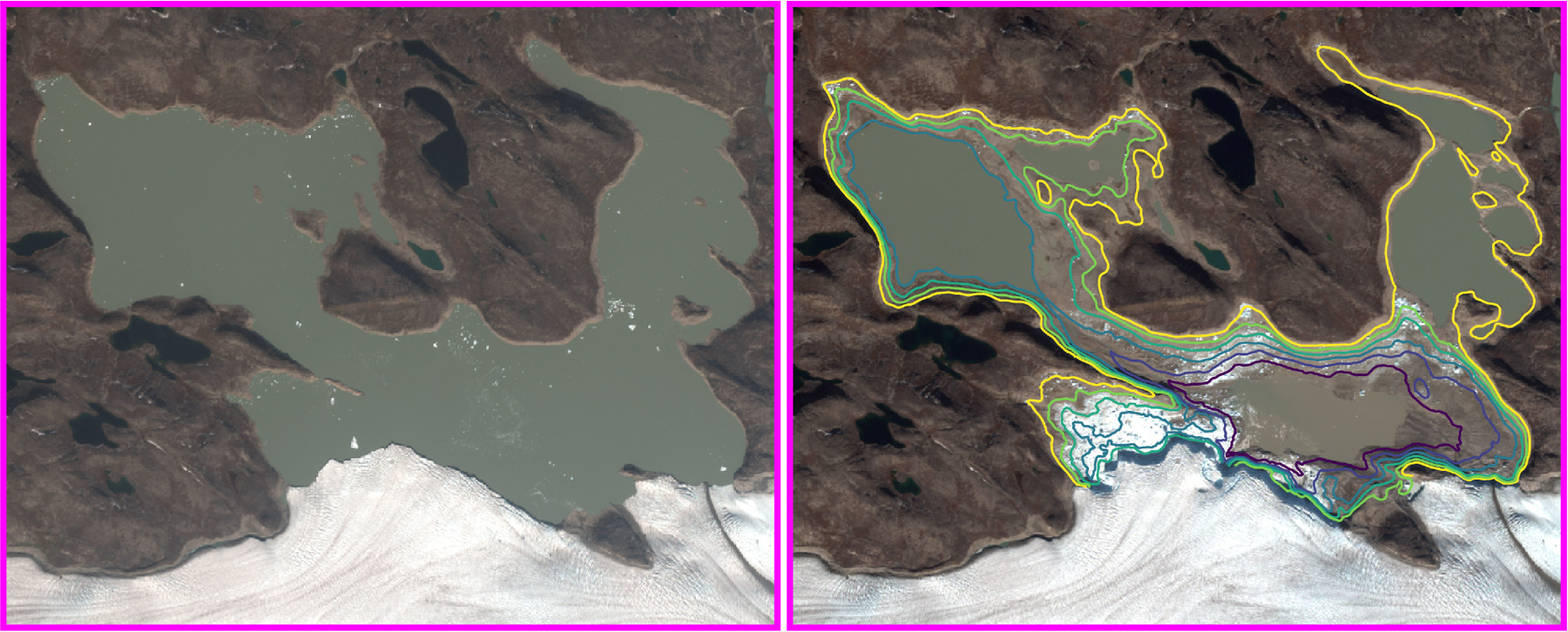
In September 2022, an ice-dammed lake in southwest Greenland lost roughly 400 billion gallons of water within 24 hours. As the flood rushed beneath a neighboring glacier, ice near the front briefly moved about five times as fast as it had before. Then the glacier slowed. Near its front, the ice averaged less than a third of its pre-flood speed for more than two years.
That slowdown was part of a cycle. Glaciologist Yefan Wang of the University of Edinburgh and coauthors used satellite observations going back to 1987 to document four big floods from the same lake, roughly a decade apart. The glacier gradually sped up between floods, and each major drainage event abruptly returned it to a slower pace, the team reports in Nature Communications.
After the 2022 flood, laser measurements from NASA’s ICESat-2 satellite helped reveal a broad depression in the ice surface. The researchers interpret it as the trace of a channel the flood carved beneath the glacier. At first, they think, the rush of water raised pressure beneath the ice, helping it slide. Once the channel carried away water trapped beneath the glacier, the pressure fell and the ice pressed harder against the ground.
The channel itself may have closed quickly as the ice slowly deformed. But “the multi-year suppression of ice speeds does not rely on this channel remaining physically open,” the researchers write. They think it took years for water pressure to build again. That cycle could matter for projections of how much ice Greenland sends to the ocean. How widespread the effect is remains open.
The research
Cyclical high-magnitude lake drainage slows Greenland ice sheet motion ↗
Yefan Wang, Peter Nienow, Jaime Otero and Daniel N. Goldberg
Nature Communications · Accepted
DOI: 10.1038/s41467-026-79659-3