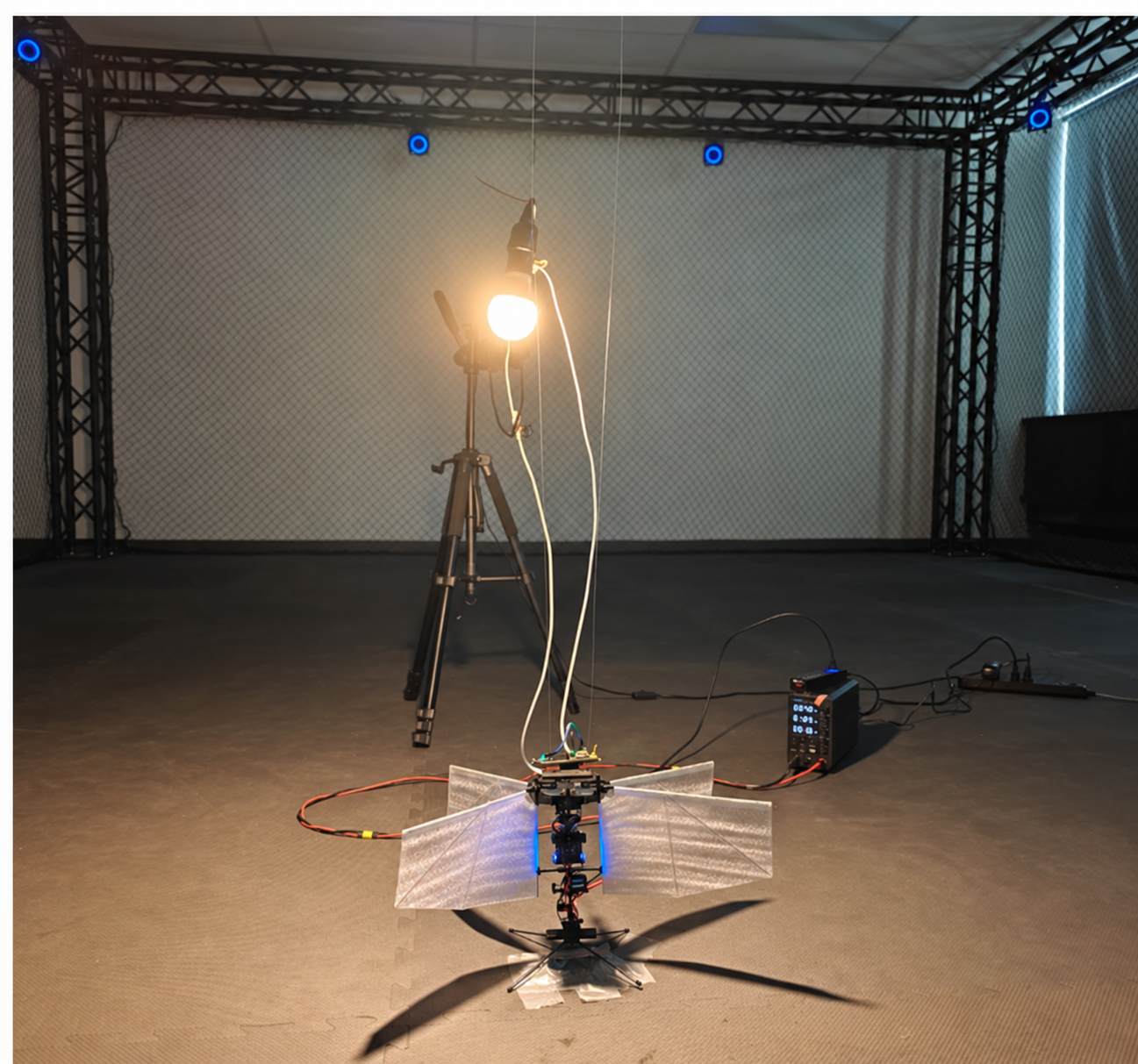
A wing-flapping robot rises toward a light bulb, steadies itself nearby and follows when the bulb is moved. In laboratory tests, that behavior depended on readings from a light sensor, rather than instructions specifying where the lamp was or how high the robot should fly.
Simone Martini and colleagues in aerospace engineering at the University of Cincinnati tested a simple way to guide flapping flight. Their study, accepted in the journal Physical Review E, puts an earlier mathematical proposal into practice: the same wingbeats that produce lift can also help a flying machine find a place to hover.
The approach uses small variations in the light reaching a sensor on the robot's head as the wings flap and the body moves. A feedback loop combines those readings with the flapping oscillation and continually adjusts the commands driving the robot. This lets it seek stronger light without a detailed calculation of the forces acting on its wings or a map of the light field. The researchers call the method natural hovering extremum seeking, a form of continuously probing and adjusting toward a maximum or minimum.
The machine was kept on a limited flight path. Two parallel guide lines prevented it from wandering sideways, and the researchers changed the spacing of guides on its body to either restrict or allow pitching, the forward-and-back tilt of the body. The experimental setup used a robot with a wingspan of about 49 centimeters, an external power supply and a separate computer running the controller.
In an initial check, a camera-based tracking system supplied height measurements so the robot could aim for a preset altitude. In the subsequent light-seeking experiments, the controller instead used the body-mounted light sensor. It received no measurements or estimates of the robot's height or pitch angle and no coordinates for the bulb.
The robot approached a fixed light and settled into a hover. When researchers moved the bulb, it adjusted and stabilized again without retuning the controller. In tests that also allowed pitching, the feedback loop adjusted both the flapping motor command and the pitch-servo command. In one illustrated trial, the sensor rose from about 22 centimeters above the ground to 66.5 centimeters, while the body settled at a tilt of about 20 degrees.
The system also operated with noisy sensor readings and delays in its wireless control loop. These demonstrations show that the idea can work in physical hardware, although they do not establish how reliably it would perform in wind or in an unrestricted flight. The paper leaves three-dimensional source seeking and hovering for future work.
No live insects or hummingbirds were tested. The results therefore do not establish that animals use this control mechanism, or explain why moths gather around lamps. For flying robots, the appeal is a way to get more from a motion already needed for flight: each wingbeat can help keep the machine aloft while also supplying information to guide its next adjustment.
The research
Simone Martini, Rohan Palanikumar, Ahmed A. Elgohary and Sameh A. Eisa
Physical Review E · Accepted
DOI: 10.1103/mbzs-j8g9