Draw a serrated knife through a piece of food and you can feel how a slicing motion helps it cut. A test with a replica dinosaur tooth found a similar advantage. Pulling the tooth diagonally backward through a block of gelatin took about a third less peak force than pushing it straight down to the same depth.
Manabu Sakamoto, a paleobiologist at the University of Reading in England, led the study with Philip S. L. Anderson, who studies the mechanics of puncture at the University of Illinois Urbana-Champaign. Many meat-eating dinosaurs had curved teeth with serrations on both edges. The researchers wanted to find out how much the direction of the bite mattered, they report November 25 in Palaeontology.
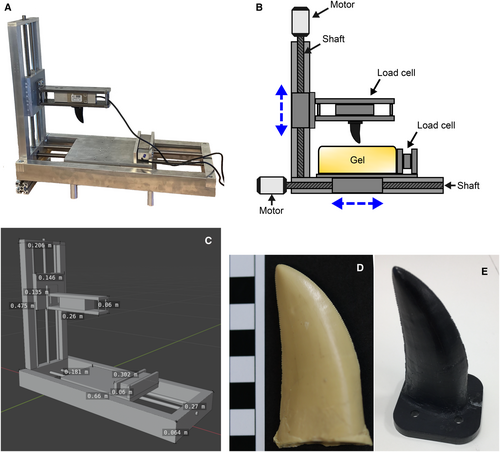
The team mounted a resin copy of a fossil tooth from Portugal, probably from a relative of Allosaurus, in a machine called DinoSAW. The machine pushed the tooth straight down or drew it down and back through gelatin, a stand-in for flesh. In 12 trials of each motion, the average peak force dropped from 21.4 newtons for the straight push to 14 for the diagonal pull.
Color patterns that appeared in the gel under polarized light showed where stress built up in the material. The straight push concentrated stress around the tooth. The diagonal pull spread it more evenly along both serrated edges. The experiment used one tooth shape and a straight diagonal path. A real jaw could sweep through an arc, and the researchers didn’t test differently shaped teeth like those of tyrannosaurs.
Grooves on fossil bones offer another clue that some dinosaurs dragged their teeth backward. The authors point to a motion you can still see in living animals. Komodo dragons tug at flesh with their serrated teeth, and birds of prey dig in their curved beaks and pull with their necks.
“motions in line with the shape of the teeth (diagonal pull-cutting) result in more efficient cutting compared to simple vertical puncturing”— The authors write in Conclusion; quotation from the publication
The research
Manabu Sakamoto and Philip S. L. Anderson
Palaeontology · Published
DOI: 10.1111/pala.70096