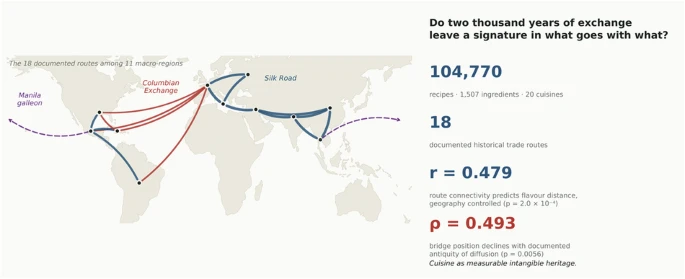
Historical trade routes appear to have left an imprint on the flavors of modern cuisines. A study drawing on nearly 105 thousand recipes found that historical trade connections predict culinary similarities better than geographic location does.
Researchers in China assembled recipes from three datasets, using a network of 1,507 ingredients and their shared flavor compounds. For their comparison of 20 national cuisines, they used a subset of 39,774 recipes. They compared similarities among cuisines with the connections established by 18 historical trade routes, including the Silk Road, Indian Ocean spice routes and the Transatlantic trade.
Cuisines connected by well-traveled trade-routes tended to have more similar flavor profiles, even after accounting for geographic distance. Being physically near another culture didn't matter as much to your cuisine -- being on the same trade route was a much stronger predictor of shared flavors and ingredients.
The researchers also found that ingredients introduced through historical trade served as bridges between otherwise distinct flavor traditions.
Relatively recent introductions such as tomatoes, potatoes and cocoa still connect different flavor communities, while older imports such as black pepper and cinnamon have become deeply embedded in regional cooking traditions.
The analysis used modern English-language recipes and ingredient chemistry to discover the flavor profiles of the routes. And, the researchers caution, other influences are still important in cuisines: shared cultural histories, migration and modern markets also contribute.
The research
Historical trade-route connectivity predicts the flavour map of world cuisines ↗
Jing Gao, Dong Lin and Jianfeng Hu
npj Heritage Science · Accepted
DOI: 10.1038/s40494-026-03104-3